main website
- Switch to...
- Education Website
From Buildings to Catalysts
At Solar for Schools we always say 'learn from your buildings, not just inside them'
School estates are more than buildings, they are catalysts for opportunity, inclusion and resilience. And now this is a clear direction set out in the DfE’s Strategic Estates Policy.
For schools and trusts, this represents a shift: from viewing estates as a cost to manage, to recognising them as strategic assets that can actively support educational outcomes, financial resilience and long-term sustainability.
The paper, The Education Estates Strategy, recognises that many schools are already making progress. But too often, activity remains fragmented; a series of individual projects, driven by short-term funding or immediate need, rather than a coherent, sustainable strategy.
The policy invites something more ambitious: a more joined-up approach, where estates decisions are aligned with wider organisational priorities.
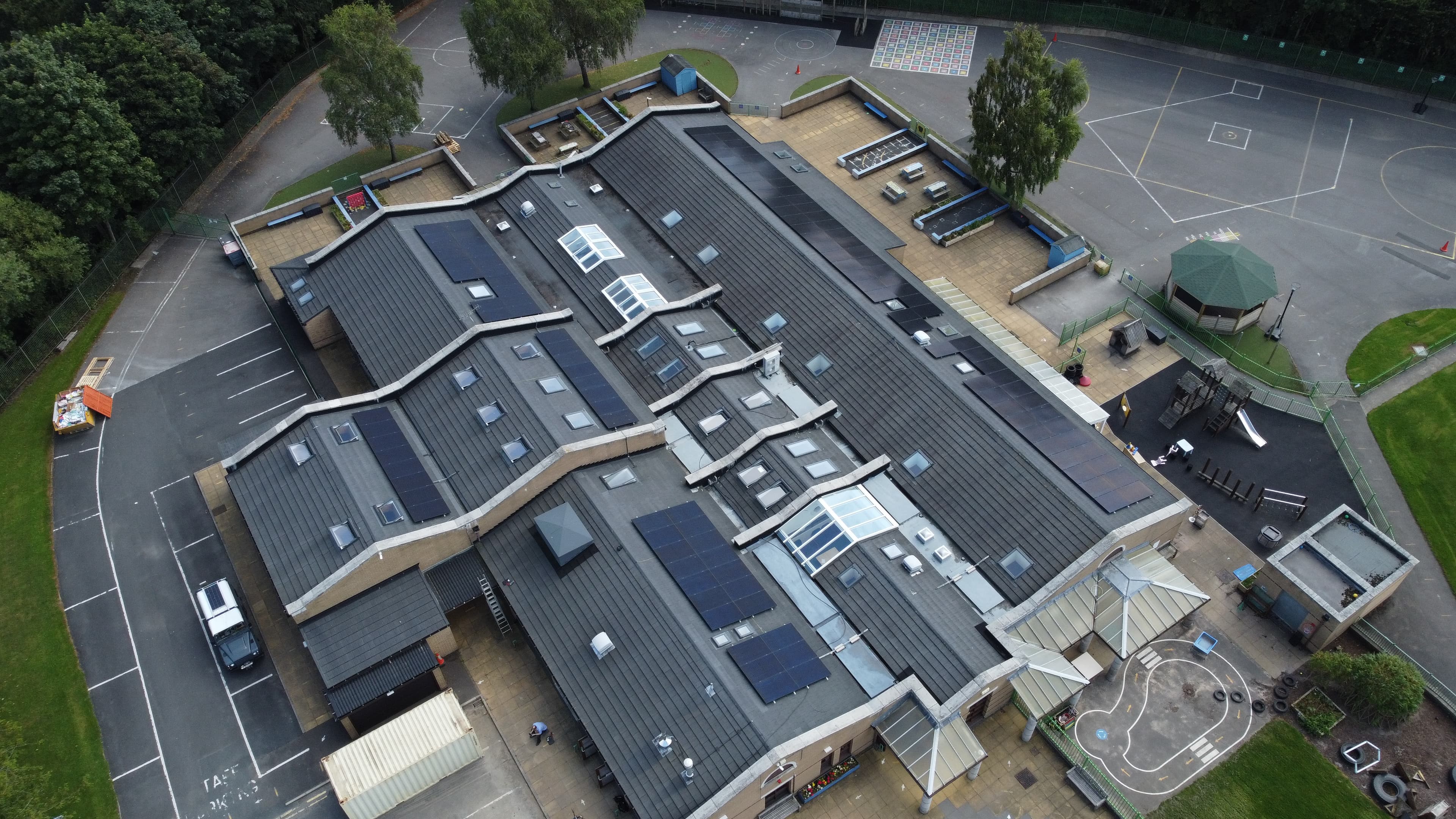
Solar is not just infrastructure
Within this context, solar is often seen as a straight-forward estates improvement, a way to generate renewable energy and reduce costs. But on its own, infrastructure only delivers part of the value.
At Solar for Schools, our approach is built on four cornerstones: infrastructure, intelligent monitoring, education and legacy. Remove any one of these, and the overall impact is reduced.
This reflects the direction set out in the DfE’s Strategic Estates Policy, moving beyond standalone projects towards integrated, long-term approaches.
Making energy visible
A key part of this shift is visibility. When schools can see, in real time, how energy is being generated and used, patterns emerge and opportunities to adjust behaviour become clearer.
This is where solar moves beyond infrastructure. It becomes a live, data-rich resource that supports both operational decision-making and learning.
Alongside this, schools have access to a dedicated education platform, bringing real-time generation and consumption data into the classroom as a teaching tool. Supported by a mobile app and in-person sessions, this helps embed learning in ways that are relevant to pupils and curriculum.
This connection between the roof and the classroom is where solar becomes something more than infrastructure. It becomes part of the learning environment.
From generation to reduction
When monitoring and education sit alongside infrastructure, schools don’t just generate energy; they often use less of it overall.
Visibility creates understanding and understanding drives behaviour change. Across our projects, this combination has been shown to reduce electricity use by around 29% on average.
A strategic opportunity for trusts
The Strategic Estates Policy encourages a more strategic, long-term approach to estates. A more strategic approach can support improved budget predictability, better use of existing assets, stronger alignment with sustainability requirements, and enhanced learning environments.
Rather than isolated projects, this is about embedding infrastructure within a wider system that delivers both operational and educational value over time.
Beyond the school gates
Schools sit at the heart of their communities. Solar can play a role here too, reducing costs and emissions while demonstrating visible leadership. Pupils take that understanding home, and awareness extends beyond the classroom.
In many cases, projects are also supported through community investment, creating a direct link between local people and the school’s transition to renewable energy.
Looking ahead
The Strategic Estates Policy makes clear that estates have a vital role to play. Solar, when approached as part of a wider approach combining infrastructure, intelligent monitoring, and education, offers one way to deliver long-term impact.
Not just as an energy solution, but as a catalyst for long-term change.


Address
Falcon House 3 King Street Castle Hedingham, Halstead Essex CO9 3ER United Kingdom
- +44 (0)1376 428984
- info@solarforschools.co.uk
We support the UN Sustainable Development Goals




© 2026 - Solar Options for Schools Ltd
Registered Company 9812345 VAT # GB232066930