main website
- Switch to...
- Education Website
A Shield Against Price Volatility
Oil, gas and energy prices are always a subject of concern and debate among both politicians and consumers. Anyone who has filled up their car with petrol or diesel or received an electricity bill will have probably exclaimed (complained!) how expensive it has become recently.
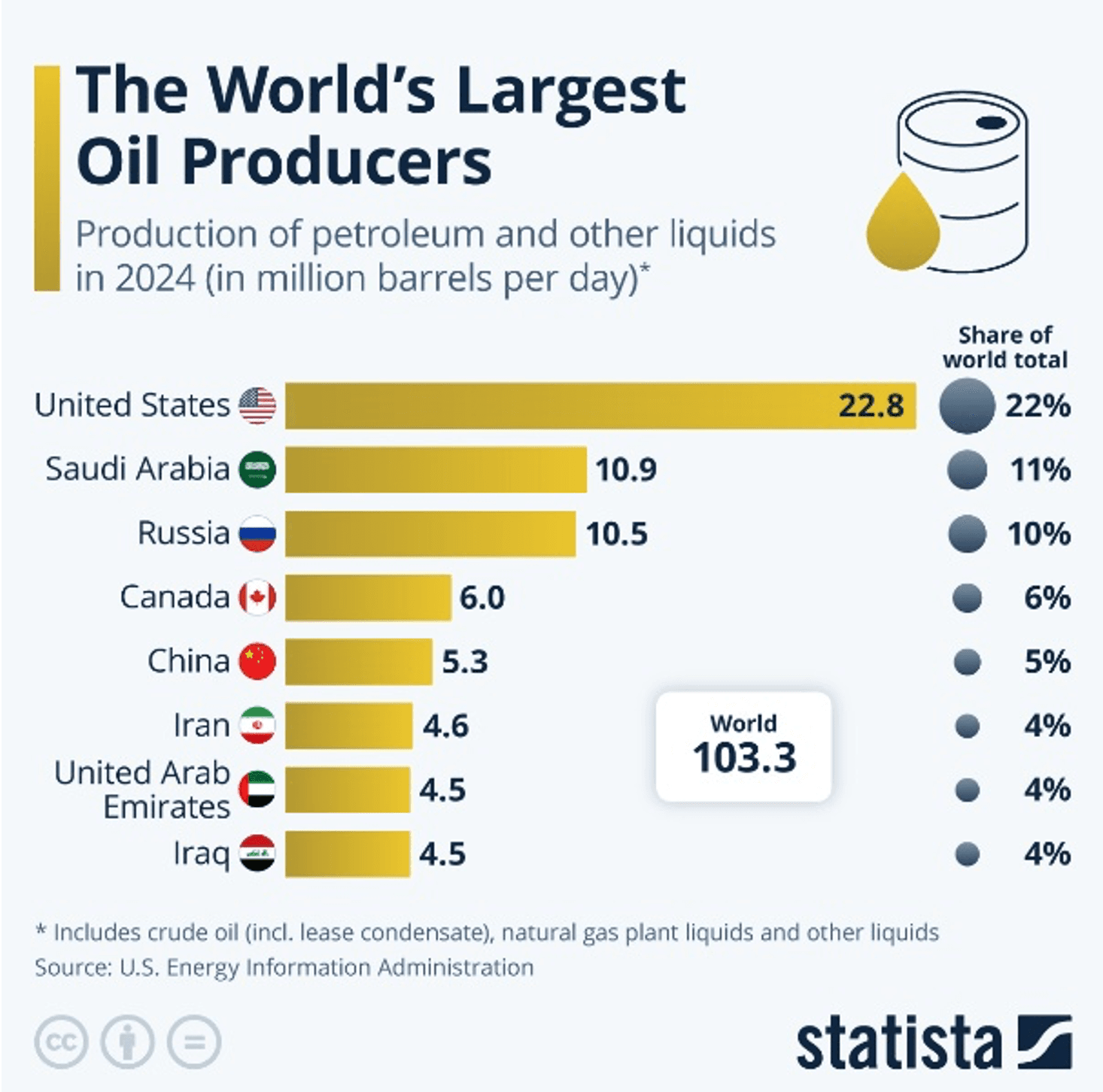
Most energy price rises can be traced back to the price of crude oil (petroleum) which is used for many things including plastics, pharmaceuticals, fertilisers, petrol, even asphalt for our roads to name but a few. Globally, it is estimated that over 100 million barrels of crude oil are consumed every day, according to the International Energy Agency, and much of this is sourced in countries across the Middle East, such as Saudi Arabia and Iran. The United States of America, China and Russia are also major suppliers. Some smaller countries like Venezuela also hold large, sometimes partially untapped, reserves.
Figure 1: Top ten oil producing countries in 2024 (Statista)
Whilst consumers bemoan prices rising, the knock-on effects of rising energy affects virtually everything you buy. After all, shops pay for their energy and any increase in costs necessitates price rises across the board.
Meanwhile, politicians and large companies are more concerned with the volatility of the market. A steady price rise can be passed down the supply chain to the consumer, and combatted with various financial measures, but volatility is harder to cope with. So far, 2026 has proven immensely volatile for petroleum prices, partly due to structural shifts in energy markets, a continuing effect from the war between Russia and Ukraine, and more recently the new emerging conflicts in the Middle East. The more upheaval there is around the globe, the more uncertainty there is about the future, and the more volatility there is in energy prices. The lower a country’s storage facilities, the more vulnerable they are to shocks in the market. Recent headlines in The Guardian suggest the UK has just two days’ of backup supply.
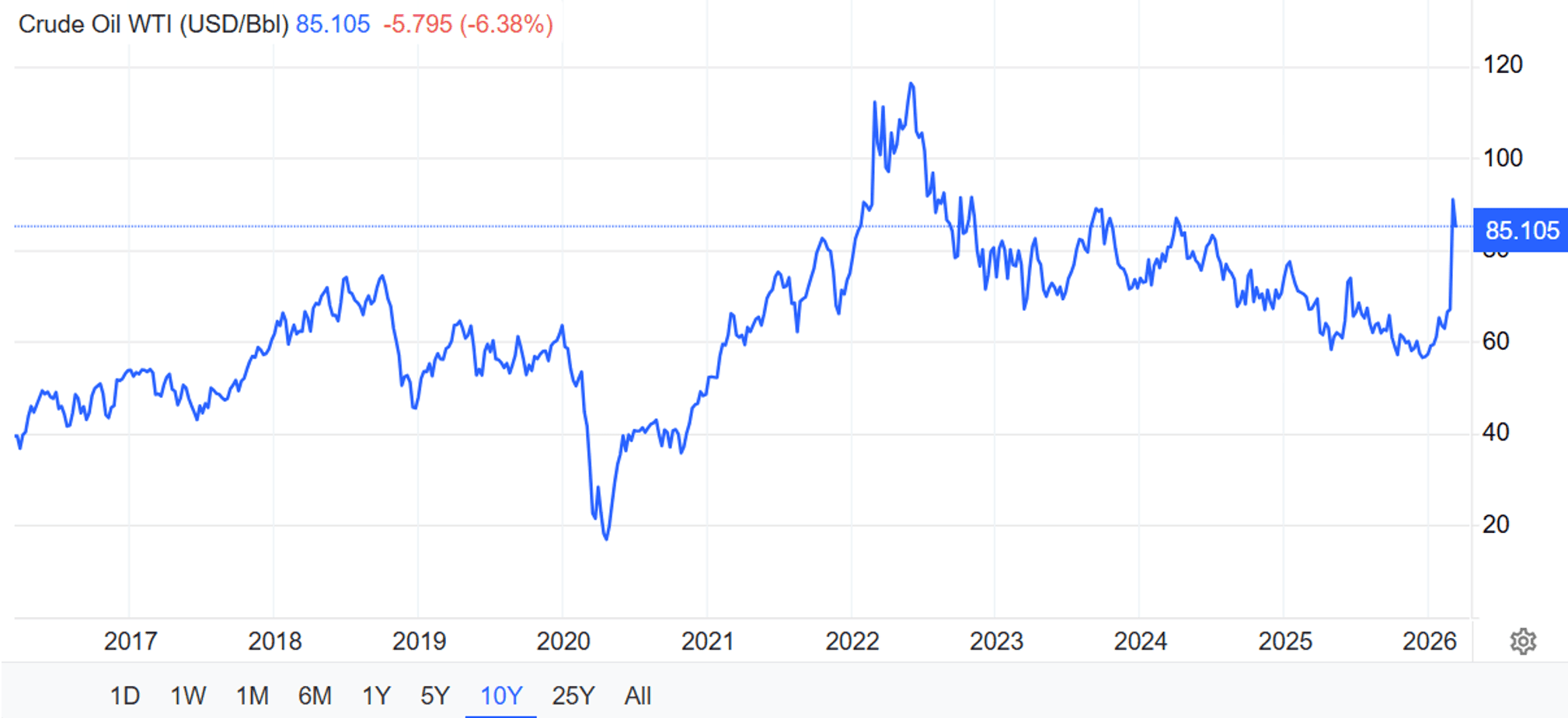
So, let’s look at the last six months in more detail. Figures 2 and 3 show graphs from Trading Economics indicating the price of crude oil in US dollars over time. As you can see, the market was reasonably stable towards the end of 2025 before rising slightly with increased uncertainty in 2026 and then a sudden spike coincided with the US attack on Iran. The last time oil and gas prices surged so markedly was in 2022 – coinciding with Russia’s attack on Ukraine in February 2022 and the resultant sanctions on Russia.
Figure 2: Price of crude oil over last six months. Accessed 11/3/26 (Trading Economics)
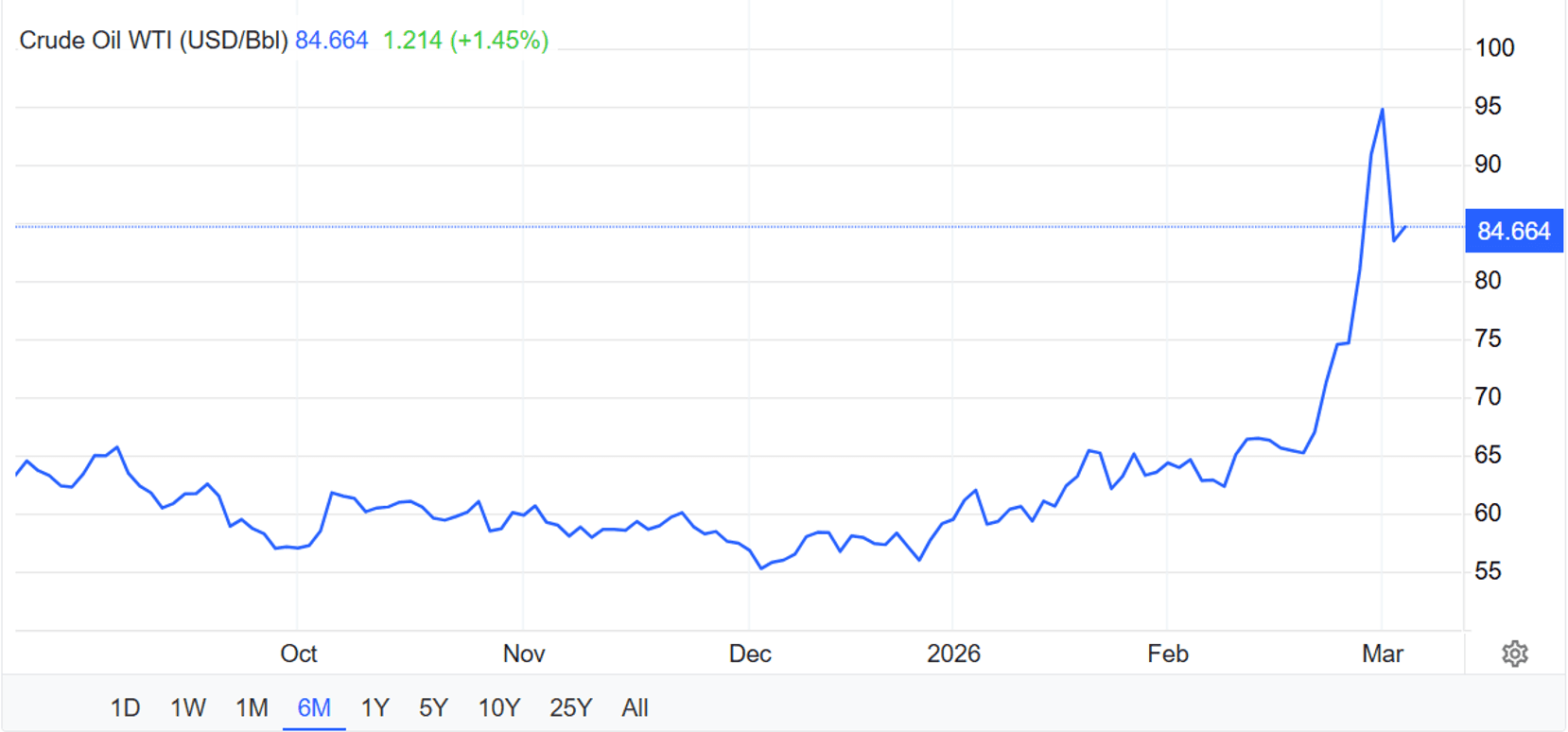
Figure 3: Price of Crude oil over last ten years. Accessed 11/3/26 (Trading Economics)
So, what does this mean personally? For smaller consumers it means price rises for goods, as previously discussed, and can create a cost-of-living crisis, as this is heavily driven by energy price rises. Large companies can often ride out the “storm”, so to speak, and absorb additional costs but for small businesses it can also have catastrophic consequences. Smaller businesses are far more vulnerable to these sorts of volatile changes in the market. Some companies see their operational costs double or even triple. They then have a choice of trying to soak up this increase by lowering their profit margins or to pass it down to the consumer and risk losing sales. If they get it wrong, it can easily lead to bankruptcy.
In addition, energy prices have a knock-on effect in financial trading markets. The increased uncertainty makes people less likely to Invest their money. This can lead to a slump in markets and financial repercussions lasting months or even years. For governments it can have short and long-lasting effects. In the short term all public services use energy – schools, hospitals, the vast majority of governmental infrastructure need power to run – which then causes a tightening of budgets and cuts to be made, or unpopular taxes to rise.
So how does all this relate to renewable energy? Well, renewable energy is far less vulnerable to geopolitical volatility as it is not being linked to the petroleum industry. Most countries can produce their own renewable energy, reducing their reliance on importing energy and their exposure to often volatile global markets. This massively reduces the impact geopolitics have on energy prices. Renewable energy projects, such as solar and wind, have an initial outlay cost, but then low operating costs allow for a fixed energy cost over time. Sunlight and wind are free, after all, unlike petroleum!
Globally many countries are beginning to see the advantage of using renewable energy sources to mitigate the effect of geopolitical uncertainty. But often due to low renewable supply and insufficient infrastructure, this tactic is currently like sticking a plaster over a wound – soaking up the short-time price volatility, but with longer term costs still ahead. However, in the future if a higher proportion of a country’s energy reliably comes from renewable sources it would help provide sustainability of supply and greater self-resilience in the event of wars or other geopolitical upheaval. Add to this, the fact that fossil fuels are non-renewable, and will become scarcer (and thus likely more expensive) over time, renewables become very attractive.
Solar power has seen immense growth over the last decade, partly driven by a 90% reduction in costs since 2010 – an average of $0.40 per kWh in 2010 to just $0.043 per kWh in 2022. (Our World in Data.) Oil fired power meanwhile averages between $0.10 and $0.15 – putting solar power over 43% cheaper on average than the newest fossil fuel powered plants. (Carbon brief.org.)
It is no surprise then that in 2025 renewable energy, driven primarily by solar and wind, experienced record-breaking growth both in the UK and globally.
These are just some of the promising statistics from the last six months:
On roughly a third of days in 2025 at least half of Britain’s energy came from renewable sources, mainly solar and wind (BBC analysis of NESO data)
The EU had similar figures – wind and solar generated more power than fossil fuels for the first time in 2025 (30% of power compared to 29%) (The Guardian)
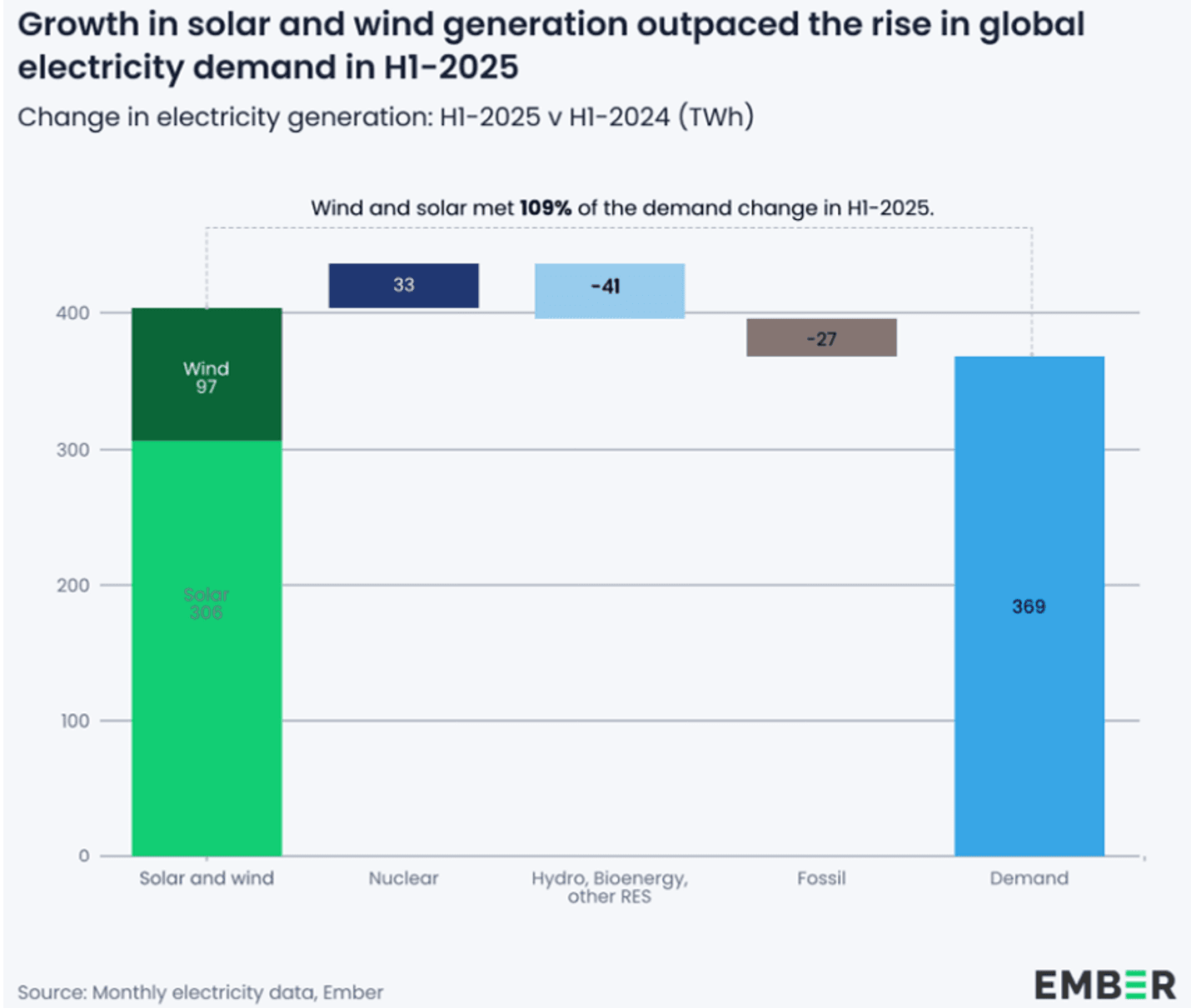
Globally renewable energy sources overtook coal as the leading source of electricity for the first time in the first half of 2025 (Ember).
2026 is forecast to be another bumper year for renewable energy with global capacity set to rise 11% to 793GW (Ember). Solar is set to become the main energy source in several countries, particularly developing countries and is projected to constitute nearly 80% of new renewable energy capacity expansion. Geopolitical upheaval will only strengthen this expansion.
Figure 4: Changes in electricity production in the first half of 2025 (Ember)
On a smaller scale small businesses including schools and other infrastructure are also often turning to renewable energy. Any business, however big or small, profits from consistency and solar panels reduce a major source of volatility (and therefore a major source of stress) for business leaders. Solar panels produce energy at a predictable rate. Peaks and troughs, according to weather and climate, can be roughly predicted in advance and therefore allowances can be accommodated. In periods of surplus, additional energy can be generated and stored for periods of deficit. In the early days of renewable energy, one criticism often levied was the uncertainty of being at the mercy of the weather. Whilst it is true that climate and weather patterns affect output; national grids and individual properties are increasingly using battery storage and other solutions to mitigate this challenge. Any additional energy can be sold back to the grid, helping to offset the initial outlay costs, as well as providing an attractive draw for consumers.
REFERENCES
The Guardian, 8th March 2026. Great Britain has only two days of gas stored, while Iran war threatens to disrupt supplies. https://www.theguardian.com/business/2026/mar/08/great-britain-has-only-two-days-of-gas-stored-as-iran-war-disrupts-supplies. Accessed 11th March 2026
BBC News, 2nd January 2026 Record year for wind and solar electricity in Great Britain in 2025. https://www.bbc.co.uk/news/articles/cz947djd3d3o. Accessed 10th March 2026
International Energy Agency, n.d. Global Energy Review. https://www.iea.org/reports/global-energy-review-2025/oil. Accessed 11th March 2026.
Ember; n.d. Global electricity mid-year insights 2025. https://ember-energy.org/latest-insights/global-electricity-mid-year-insights-2025/global-analysis/. Accessed 10th March 2026
The Guardian, 21st January 2026. Wind and solar overtook fossil fuels for EU power generation in 2025, report finds. https://www.theguardian.com/environment/2026/jan/22/wind-and-solar-overtook-fossil-fuels-in-power-generation-for-eu-in-2025-report. Accessed 10th March 2026.
Trading Economics, n.d. Price of Crude Oil over Time https://tradingeconomics.com/commodity/crude-oil. Accessed 10th March 2026
Carbon Brief, 22nd July 2025. UN: Five reasons why switching to renewables is ‘smart economics’. www.carbonbrief.org. Accessed 17th March 2026
Our World in Data, n.d. www.ourworldindata.org. Accessed 17th March 2026


Address
Osier House, Osier Way, Sible Hedingham, Essex, CO9 3FF United Kingdom
- +44 (0)1376 428984
- info@solarforschools.co.uk
We support the UN Sustainable Development Goals



© 2026 - Solar Options for Schools Ltd
Registered Company 9812345 VAT # GB232066930